How Humidity in Southeast Asia Affects Wood Bedroom Decor — And What To Do About It
Last month I visited a friend's resale HDB flat in Bedok, and the first thing she pointed at was her three-year-old solid wood bed frame. The side facing the shared corridor wall had a faint darker band running along the panel, and the drawer fronts on her wardrobe no longer sat flush. Her air-conditioner had been running for most of those three years, yet the bed frame had still moved. The culprit, I told her, was not the air-conditioner but the 1.5-metre-wide service corridor behind her wall, which traps humid air against the back of the furniture every night. That single visit is the reason I keep a humidity meter in my toolbox when I visit clients across Tampines, Punggol and the older blocks in Toa Payoh.
Singapore sits in a tropical band where the average relative humidity sits between 70% and 85% for most of the calendar year, and indoor humidity in a typical HDB flat rarely drops below 60% even with daily air-conditioning. If you have invested in solid wood bedroom decor — a bed frame, a wardrobe, a pair of nightstands, maybe a marble-topped dresser — that humidity is quietly working on it every single day. This guide explains what the moisture is actually doing to the wood, how it interacts with the way most Singaporean bedrooms are laid out, and what practical steps keep the pieces looking right for the long run. The advice applies whether you have just moved into a new BTO in Punggol or you are refreshing a condo in the East.
What the tropical climate is doing to a solid wood bed frame
Wood is hygroscopic, which is a polite way of saying it absorbs and releases moisture from the air for its entire life. In a Tampines HDB where the indoor relative humidity drifts between 65% and 82% across the year, a solid wood bed frame made of ash, oak, or walnut will gain moisture during the wetter months (November to February, and again in June) and lose it during the drier weeks when windows stay shut and the air-conditioner runs for ten hours a day. That slow breathing causes the panels to expand by 1 to 3 millimetres across their width, which is enough to push drawer faces out of alignment and open hairline joints along a headboard.
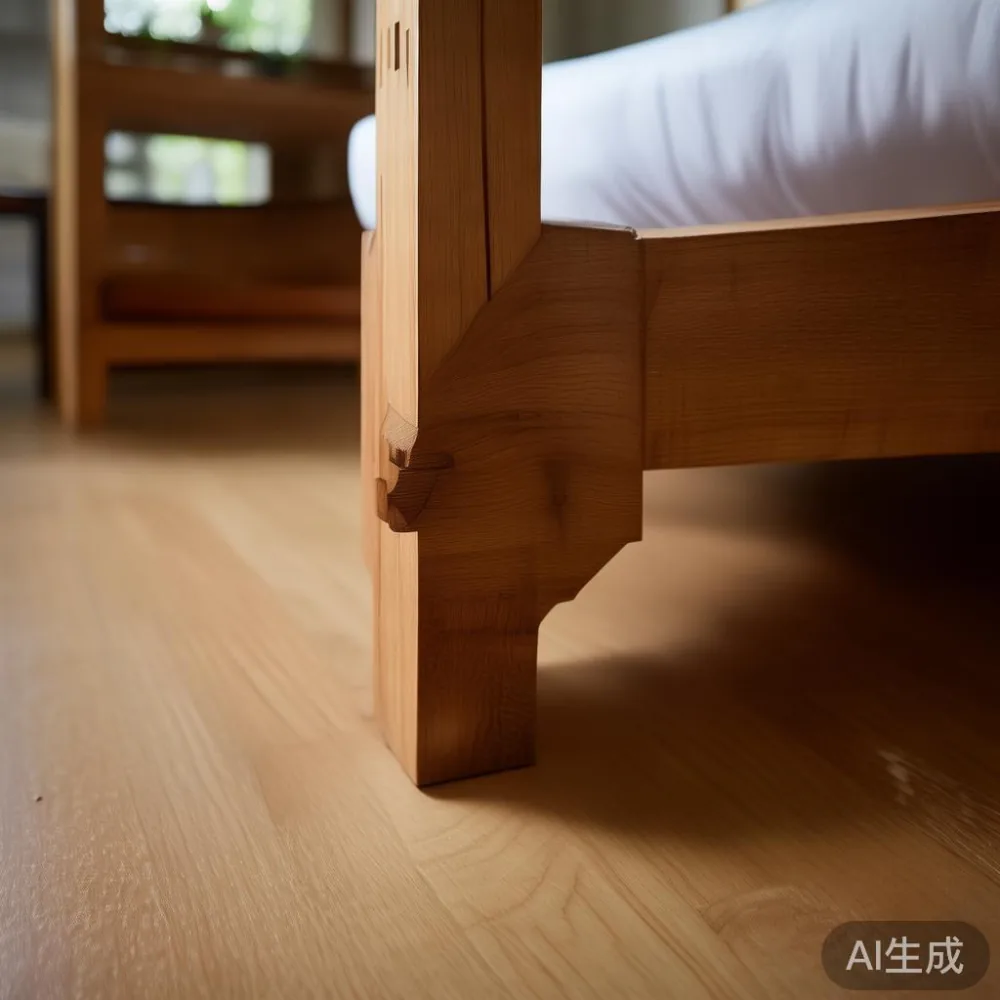
The MDF-backed and veneer-clad alternatives behave differently. They do not move as much in the short term, but when the humidity finally wins — usually after three to five years in an unventilated HDB bedroom — the laminate peels, the substrate swells, and the piece is finished. A 1.8-metre by 2-metre solid wood bed frame from a maker like MIDHILL, built with traditional mortise-and-tenon joinery and kiln-dried timber at 8% to 10% moisture content, tolerates this movement for a decade or more, and the joints can be tightened by a refinisher instead of replaced.
Why HDB layouts and lift dimensions change the equation
Most people blame the weather, but the building itself is half the story. HDB service yards in newer BTOs are often separated from the bedroom by a single non-insulated partition, and corridor walls in older blocks run directly behind the master bedroom wardrobe. The air behind that wall is consistently 3 to 5 degrees cooler and 5% to 10% more humid than the air-conditioned bedroom, which sets up a slow moisture migration through the back panel of every wardrobe and bed frame pressed against it.
Lift dimensions matter on moving day, and they matter again later. A standard HDB passenger lift cabin is about 1.1 metres wide by 1.4 metres deep with a door opening of roughly 0.9 metres, which is why most solid wood dining tables and bed frames ship knocked-down with a flat-pack width of under 60 cm. The pieces go up the lift, through the corridor, and into the bedroom without a scratch. They were designed for that journey. Years later, the same compact shipping form is why a refinisher can take the wardrobe apart in your room, sand each panel on-site, and rebuild it without dragging it back down the lift. MIDHILL ships this way from Foshan for a reason, and that reason is the HDB.
How humidity affects specific pieces of bedroom decor
Not every piece of bedroom decor reacts the same way. A solid wood nightstand, because it is small and has exposed ends on all four sides, equalises with the room humidity in under six hours and tolerates the daily swings. A 2-metre-tall wardrobe is a different animal: the top panel sits 30 cm from the ceiling where the air is warmer and drier, while the bottom panel sits on a cooler floor that often reads 75% to 80% relative humidity on a hygrometer. That temperature and humidity gradient across 200 cm of height is what warps doors and twists frames.
Beds respond mostly at the slats and the side rails. Slats dry out, shrink by 1 to 2 mm, and begin to creak against the side rails after the second or third dry season. Side rails cup slightly inward and pull the slats into a shallow U-shape, which is why a bed that felt solid in the showroom can start to feel bouncy after eighteen months in a Punggol condo. A marble table used as a dresser top is the most stable surface in the room because marble does not move with humidity, but it does transfer cold into the wood beneath it, which causes localised condensation in the mornings. A felt pad or a thin cork liner between the marble and the wood solves that in five minutes.
Is a bookshelf worth the price in Singapore?
Yes, a solid wood bookshelf is worth the price in Singapore when it is built from kiln-dried timber with adjustable shelves and a back panel that allows air to circulate, because the higher price buys joinery that tolerates humidity for fifteen years instead of warping in three. A flat-pack bookshelf from a general retailer starts around SGD 180 to SGD 280 and uses particleboard with a paper laminate that swells within the first serious wet season; a proper solid wood bookshelf with through-tenons and floating shelves sits between SGD 1,400 and SGD 2,600 for a 1.8-metre unit and stays straight through a decade of HDB humidity. The price gap pays for the timber, the joinery, and the lifetime refinishing that keeps the piece serviceable when the surface gets dull. In a small bedroom, a bookshelf doubles as a display for bedroom decor items and a structural anchor for the wall behind the bed, which is a quiet bonus.
What the numbers say: a humidity budget for your bedroom
Wood furniture performs best when the indoor relative humidity stays between 45% and 60%. Singapore's outdoor humidity sits between 70% and 90% for most of the year, so the gap between outdoor and indoor conditions is between 20 and 40 percentage points of moisture that your air-conditioner must remove every day. A 1.5-horsepower inverter system in a 12 sqm bedroom pulls roughly 1 to 1.5 litres of water from the air across an eight-hour night cycle, which is the amount of moisture that would otherwise be sitting in the grain of your bed frame and wardrobe.
Two cheap tools tell you whether the system is keeping up. A digital hygrometer costs SGD 12 to SGD 25 at any neighbourhood electronics shop in Tampines Mall or Bedok Mall, and a small dehumidifier rated at 12 litres per day runs about SGD 180 to SGD 260. Place the hygrometer on the wardrobe top, 30 cm from the ceiling, and check it after a week. If it reads above 62%, the room needs more airflow or a longer air-conditioner cycle. If it reads below 45%, the timber will dry out too quickly and the surface can hairline-crack along the end grain. The target band is the same target band a piano technician sets for a grand piano in a concert hall, and the reason is identical: kiln-dried wood is happier in a controlled band than in a tropical average.
Practical maintenance for solid wood bedroom decor in the tropics
Maintenance in a tropical bedroom is not complicated, but it is consistent. Once a month, wipe every solid wood surface with a barely damp microfibre cloth — water only, no all-purpose spray — to remove the fine dust that holds moisture against the finish. Every three months, apply a thin coat of hard wax oil or beeswax conditioner, especially on the end grain of bed frames and the tops of wardrobes where moisture escapes fastest. Keep a 5 cm gap behind every wardrobe and bed frame so the wall-side panel can breathe; a 2.5 cm gap is the absolute minimum and you will see the difference in two wet seasons.
Avoid the temptation to put bedroom decor pieces in front of the service yard door or directly under a window that gets the afternoon sun on the west side of the flat. The thermal cycling there — sun at 33 degrees Celsius in the afternoon and 26 degrees Celsius after sunset — pushes the timber harder than steady humidity ever will. If your bedroom has only one wall free for the wardrobe, that wall is the one furthest from the bathroom door, which is the single biggest source of indoor humidity after the kitchen. Move the wardrobe 30 cm away from the bathroom door if you can, and the wood will settle into a much narrower humidity band across the year.
How MIDHILL approaches bedroom decor for tropical homes
Brands that ship into Southeast Asia from temperate factories often underestimate how much the joinery has to be tuned for the climate. MIDHILL has been building solid wood bedroom decor out of its Foshan workshop since 2008, and the pieces that leave the factory are kiln-dried to a 8% to 10% moisture content that sits roughly in the middle of Singapore's typical indoor range. That target means the wood swells a little in your flat, not a lot, and the joints stay tight across both the wet and the dry halves of the year. The pieces also ship flat-packed to fit a standard HDB lift and arrive with a 10-year structural warranty, lifetime refinishing, free shipping over US$350 (about SGD 480), and a 14-day return window. A 1.8-metre solid wood bed frame in ash runs around SGD 1,850 to SGD 2,400 depending on the headboard, a matching wardrobe lands between SGD 2,600 and SGD 3,800, and a set of two nightstands sits near SGD 480 to SGD 640. All prices exclude the 9% GST that applies at the point of delivery.
Choosing light-luxury pieces that handle humidity well
The light-luxury aesthetic — French light luxury with brass-tipped legs and rounded upholstered headboards, or American light luxury with cleaner shaker lines and matte finishes — pairs naturally with solid wood because the joinery is the design. Post-modern light luxury leans harder on marble accents, and a marble-topped nightstand is one of the smartest purchases for a tropical bedroom because the marble does not move with humidity and the wooden base can be specified in kiln-dried ash. A solid wood dining table from the same line, used in an open-plan living room that connects to the bedroom, keeps the timber grain consistent across the flat and reduces the visual noise of mixed materials. The pieces are heavier than their veneer cousins — a six-seater solid wood dining table weighs 90 to 120 kg, and a king-size solid wood bed frame lands between 75 and 110 kg — which is also why they sit still on a Punggol floor that vibrates when the MRT passes underneath.
FAQ: short answers to common Singapore questions
Does air-conditioning alone protect a solid wood bed frame? Air-conditioning removes moisture while it runs, but the bed frame still breathes for the sixteen hours a day the system is off. Air-conditioning is necessary but not sufficient; a gap behind the wardrobe and a monthly waxing complete the job.
How long does delivery take to a HDB in Tampines? Sea freight from Foshan to Singapore takes 12 to 18 days, and the last-mile delivery to a Tampines HDB is 2 to 4 working days, so the typical timeline is 14 to 22 days from order to your bedroom.
Can a warped wardrobe be repaired on-site? A skilled refinisher can take a knocked-down wardrobe apart in your bedroom, plane each panel back to true, replace the affected veneer or laminate, and reassemble it within a single working day. Pieces that ship flat-packed in under-60-cm cartons, the way MIDHILL ships them, are built for this kind of service.
What about Japandi solid wood minimalist furniture in a small HDB bedroom? The Japandi solid wood minimalist furniture category suits HDB bedrooms particularly well because the clean lines, low profile, and pale ash or oak finishes read larger in a 10 to 12 sqm room, and the kiln-dried timber stands up to the climate without the bulk of heavier French or American silhouettes.
A short checklist before you buy bedroom decor in Singapore
Before you sign for a solid wood bed frame, wardrobe, or nightstand in Singapore, run through this checklist. Confirm the timber is kiln-dried to a published moisture range. Ask whether the piece ships flat-packed at under 60 cm per carton, which signals that the maker thought about HDB lifts before the factory cut any wood. Check the joinery: through-tenons, mortise-and-tenon, or dovetail drawers beat dowels and staples in a tropical climate. Ask about the warranty in years, not months, and whether refinishing is offered for the life of the piece. Finally, measure the gap between your planned furniture wall and the opposite wall, and make sure you can leave 5 cm behind every tall piece. A bedroom decorated this way stays calm, stays straight, and ages the way solid wood is supposed to age — slowly, and with character.